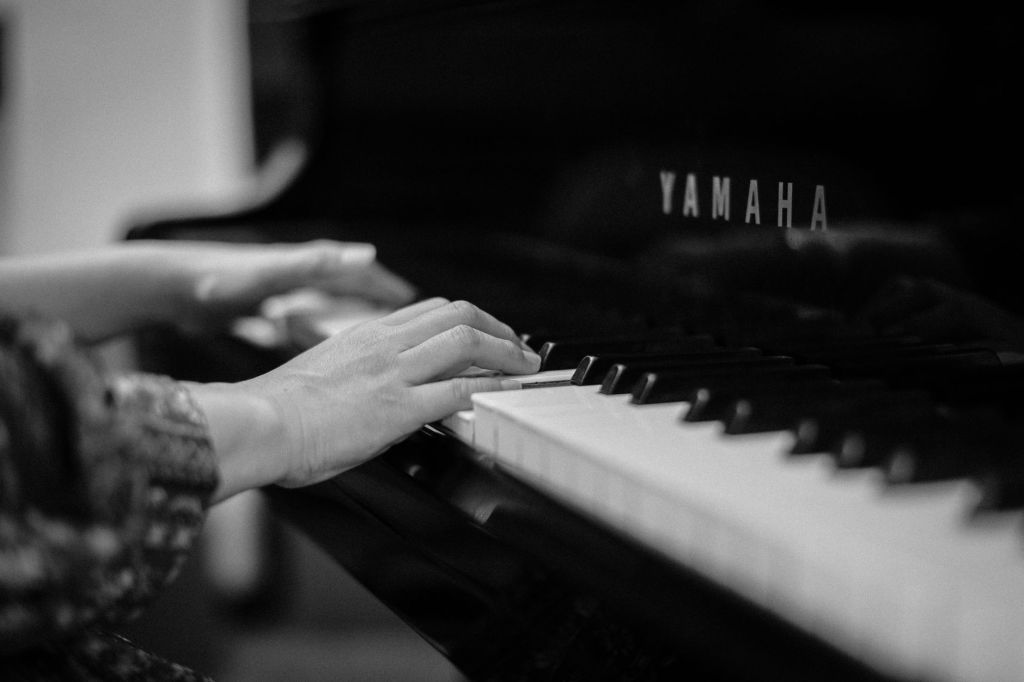
On May 1st, Vox Novus returned to the Queens New Music Festival in an evening led by Robert Voisey, director and presenter of Vox Novus and its signature Fifteen-Minutes-of-Fame project. Held at Culture Lab in Long Island City, the program brought together composers from many countries, performers, dance, performance, harp, piano, toy piano, violin, and the moving body.
The evening opened with music by Jane Wang. There was something deeply symbolic about this beginning, as if the night first opened a delicate window before leading us into a true sonic journey.
It was not only a concert.
It was a passage.
The first part, performed by harpist Alyssa Reit, seemed to belong to the realm of light. The harp appeared as cloud, breath, aura, bird, blue sky. At moments, the sound seemed to touch not only the ears, but the subtle field around the body. There was a delicate verticality in it, almost angelic, as if each string opened a thread between the visible and the invisible.
The attuned harp.
It was music made of air, brightness, and passage. A call to remember that beauty still exists, even when we are tired, even when the world feels heavy, even when the soul seems to have forgotten its own wings.
Then, with the entrance of piano and violin, the field changed. The light of the harp gave way to a denser, more embodied, more shadowed region. The music seemed to descend into the womb. Images of birth, inner water, tension, fear, and contraction emerged. It was no longer only the announcement of something greater. It was the effort of something trying to be born.
The violin carried an almost annunciatory line, while the piano gave body and gravity to the process. The sensation was that of life struggling to pass through a narrow gate. Difficult, yet alive. Painful, yet necessary.
The evening revealed a profound truth: light may announce, but birth happens through shadow.
Later, with Eunmi Ko at the piano, and then with the toy piano, the festival entered another layer. The crystalline sound brought a sense of childhood, discovery, and a newly born world. After the pain of birth came the pulse of life: sometimes strong, sometimes serene, alternating impulse and delicacy, like a new consciousness discovering the space around it.
The toy piano, with its small and luminous sound, seemed to open an enchanted forest. Images of crystals, rays of light, playful spirits, approaching shadows, encounters with the unknown, symbolic death, and slow rebirth began to appear. There was something both playful and unsettling, as happens with true images of the unconscious: they are never only beautiful, nor only dark. They are alive.
In the second part, through the choreographic collaboration of Rachael Kosch and the presence of dancers and performers, music gained a body. Sound was no longer only heard; it was seen, embodied, crossed by gestures, figures, and presences.
Dancers entered one after another: solitary figures, symbolic children, aquatic presences, fairies, priestess-like figures, pairs in tension, bodies that seemed to duel, play, search, fall, rise, and gather. At moments, the scene resembled a living mandala: many parts of the psyche appearing one after another, each with its own color, function, and language.
There was a golden figure that seemed to carry the presence of the Self: delicate, yet sovereign. There was a divine child, like a promise of renewal. There was solitude, then communion. There was multiplicity, then gathering.
At the end, all the dancers came together. The piano sustained the rhythm, as if behind so many figures there was a single pulse. Each body seemed to represent a different part of the soul, and all of them returned to the same field.
Only then did the small colorful building blocks on the stage fully reveal their meaning. At first glance, they seemed like playful objects. But after the journey, they became a symbol: many composers, many countries, many languages, many bodies, many sounds, many miniatures, all building one musical architecture.
Each piece was a block.
Each performer, a bridge.
Each gesture, a language.
Each sound, a small dwelling place for the invisible.
Vox Novus and the Fifteen-Minutes-of-Fame project reaffirm precisely this strength: creating encounters between composers and performers, opening space for new languages, allowing brief works from different parts of the world to come together in a collective experience.
I was breathless.
For a few hours, I forgot my problems. Not through escape, but through presence. I was there with body and soul, following the music as one follows a waking dream. The night began with harp and light, descended through the shadow of birth, found the pulse of the piano, played with the crystalline sound of the toy piano, embodied itself through performance, and ended in gathering.
Perhaps this is what art does when it touches its deepest function: it returns us to the world, not only as it is, but as it may still be rebuilt.
Piece by piece.
Sound by sound.
Body by body.
Block by block.
Many countries, many voices, one sonic mandala.
And, for a moment, music reminded us that we belong to a larger work.
Texto: Instituto Anemos – A. Paulette
 Instituto Anemos
Deixe um comentário